
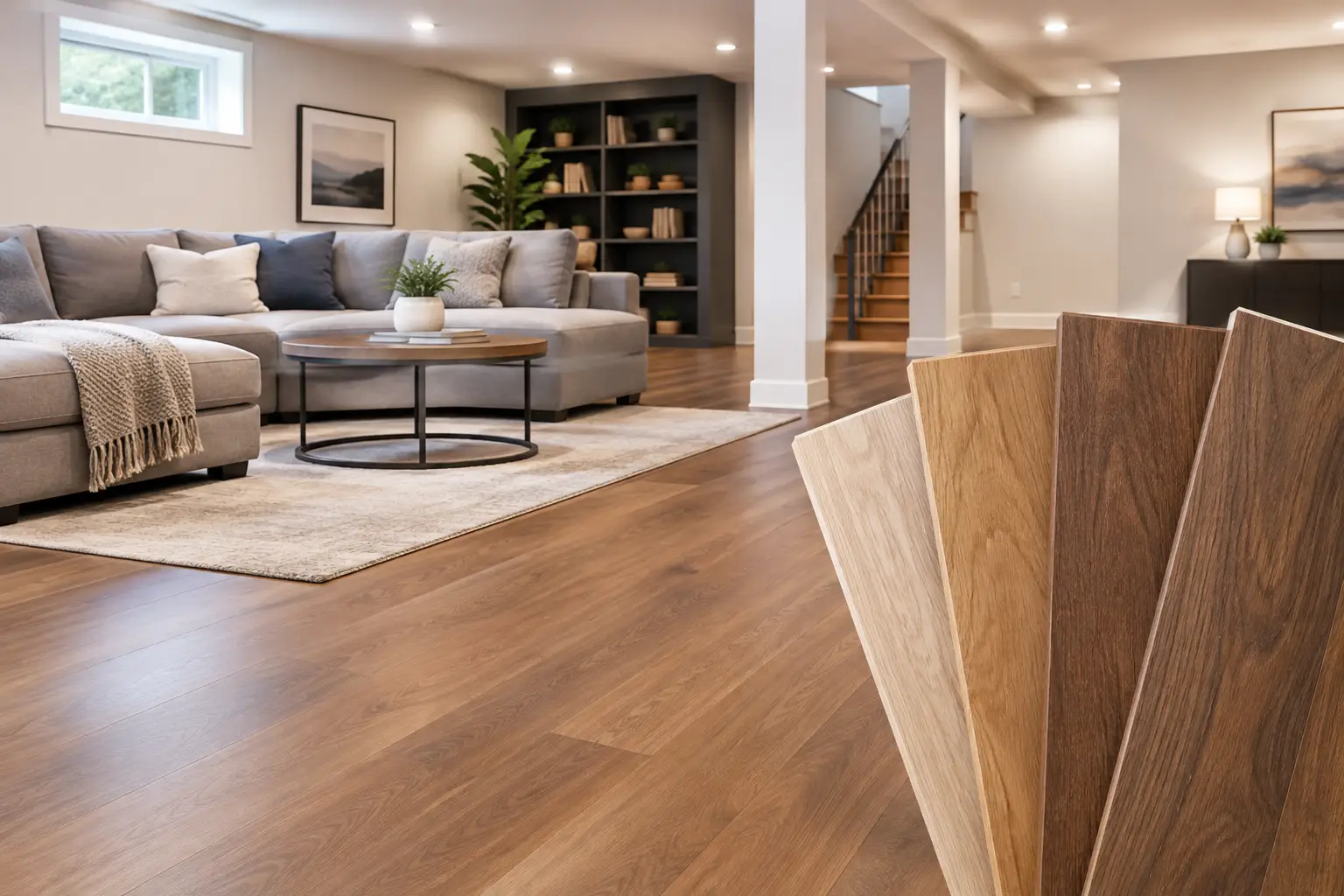
A basement floor can look perfectly dry in July and still take on enough seasonal moisture in January to damage a poorly chosen wood floor. That is why the best hardwood options for basements are not simply the hardest or most expensive boards. They are products and installation systems selected around the slab, humidity levels, drainage history, and intended use of the room.
For many Maryland and Washington, DC-area homeowners, a finished basement is valuable living space: a family room, guest suite, home office, gym, or entertainment area. It deserves a floor that feels warm, looks refined, and holds up over time. But below-grade conditions require more planning than a first-floor hardwood installation.
Why Basements Challenge Wood Flooring
Concrete is porous. Even when a basement has no visible leak, moisture vapor can move upward through the slab. Exterior grading, foundation drainage, seasonal groundwater, plumbing failures, and indoor humidity can add to the risk. Wood responds to moisture by expanding, contracting, cupping, or separating at the seams.
Solid hardwood is particularly vulnerable below grade. A traditional 3/4-inch solid oak floor needs a stable wood subfloor and a carefully controlled environment. In most basements, installing solid hardwood directly over concrete is not a sound long-term choice. It may look excellent at first, then develop movement or finish problems as conditions change.
That does not mean a basement cannot have the appearance and feel of real wood. It means the material, subfloor preparation, and moisture-control plan must work together.
The Best Hardwood Options for Basements
Engineered hardwood is the leading choice
For most finished basements, engineered hardwood is the practical answer. It has a real hardwood wear layer on top, so it provides the natural grain, variation, and character homeowners expect from wood flooring. Under that surface is a layered core built for greater dimensional stability than solid lumber.
A quality engineered product can be glued down over a properly prepared concrete slab or installed as a floating floor over an approved underlayment, depending on the product and site conditions. The right method depends on the flatness of the slab, moisture-test results, ceiling-height limitations, and whether the space may need future access to the concrete.
Not all engineered flooring is equal. Look beyond the color sample. A thicker wear layer provides more opportunity for future refinishing, while a high-quality plywood core typically performs better than a thin, low-density core. For a basement expected to serve as primary living space for years, investing in a better-built engineered floor is usually worthwhile.
Engineered oak offers a balanced, timeless result
White oak and red oak remain popular because they suit both traditional Maryland homes and more contemporary renovations. White oak is especially versatile for custom stain colors and natural matte finishes. It also has a calmer grain pattern that works well in wide-plank flooring.
For basements, engineered white oak is often the strongest all-around design choice. It can create continuity with upper-level wood floors while handling below-grade conditions more reliably than solid oak. A light natural tone can make a low-ceiling basement feel more open, while medium brown stains tend to disguise everyday scuffs and dust.
The trade-off is that very wide boards can make seasonal movement more noticeable if moisture conditions are not controlled. Wide planks are still possible, but they require especially careful slab testing, adhesive selection, and acclimation.
Engineered maple and hickory fit specific needs
Engineered maple has a clean, subtle grain that works well in modern offices, playrooms, and bright basement renovations. It is hard and visually smooth, though its tight grain can make some stains less predictable than oak. If the goal is a pale, natural floor, maple can be an excellent fit.
Hickory brings more grain variation and a more rustic appearance. It is very hard, making it appealing for active households. However, its dramatic color range and grain are not right for every interior, particularly a small basement where a calmer look may be preferred. Both options should be engineered construction when installed below grade.
Reclaimed or character-grade engineered wood adds warmth
A basement in a historic home does not have to look like a new-build recreation room. Character-grade engineered oak, textured surfaces, and reclaimed-look products can complement original millwork, brick, and older architectural details. Knots, mineral streaks, wire-brushed texture, and low-sheen finishes also make minor wear less noticeable.
These floors need the same moisture protection as any engineered wood. Their visual character may be forgiving, but it does not compensate for a damp slab or an unresolved drainage issue.
When Wood-Look Flooring Is the Better Decision
Sometimes the best flooring decision is not hardwood at all. If a basement has a history of water intrusion, regularly elevated humidity, a sump-pump concern, or a planned wet bar and bathroom, wood-look luxury vinyl plank or porcelain tile may offer better protection.
Luxury vinyl plank is comfortable underfoot, water-resistant, and available in convincing oak and hickory visuals. Porcelain tile is even more water-resistant and can work beautifully with radiant heat, although it feels firmer and cooler. These materials do not deliver the same natural depth as real wood, but they can be the responsible choice where moisture risk remains unresolved.
A professional evaluation should be candid about this distinction. Flooring should never be used to cover up a foundation, plumbing, or drainage problem.
Moisture Testing Comes Before Product Selection
The installation begins with the concrete, not with a wood sample. A basement slab should be checked for flatness, cracks, surface contaminants, and moisture vapor. Professional installers commonly use calcium chloride testing, in-situ relative humidity testing, or both, based on the flooring manufacturer’s requirements.
The results guide the next step. Some slabs may be ready for an approved adhesive system. Others need a moisture-mitigation coating, crack repair, leveling compound, or a raised subfloor system. Skipping this stage to save time can put the entire floor at risk.
Humidity should also be managed after installation. A dehumidifier, dependable HVAC system, and prompt attention to plumbing leaks help keep the basement environment stable. This matters just as much for engineered flooring as it does for solid wood.
Installation Details That Protect the Floor
A durable basement wood floor depends on details that are easy to overlook once the room is furnished. The slab must be flat enough for the selected product. Low spots can cause a floating floor to flex, while high spots can prevent boards from seating correctly. Adhesive coverage must match the manufacturer’s specification, and expansion space must be preserved around walls, columns, and fixed cabinetry.
If the floor is glued down, the adhesive should be compatible with both the product and the moisture conditions. If it floats, the underlayment must be approved for that exact floor. A generic pad or a shortcut around a vapor barrier can void a warranty and create performance issues.
Transitions deserve planning too. Basement ceiling height is often limited, so the thickness of the flooring, underlayment, moisture barrier, and any subfloor system affects doors, stairs, and connections to adjacent rooms. Good planning prevents awkward reducers and unexpected carpentry adjustments later.
Choose the Finish for Basement Life
A low-sheen matte or satin finish is usually more practical than high gloss in a basement. It reduces glare from recessed lighting and hides light scratches better. Lighter finishes can brighten an enclosed room, but very pale floors may show dirt in high-traffic family spaces. Mid-tone oak remains a dependable choice for homeowners who want warmth without constant visual maintenance.
For a custom result, stain samples should be tested against the room’s lighting, wall color, and any existing upper-floor wood. The same stain can look dramatically different in a basement with limited natural light. This is where an on-site sample board is more useful than choosing from a small showroom chip.
A Basement Floor Should Be Built Around the Space
The right basement flooring is not chosen by species alone. It is chosen after understanding the slab, the room’s purpose, moisture history, desired color, and the homeowner’s tolerance for future maintenance. For many homes, a quality engineered oak floor with proper moisture preparation delivers the most convincing and lasting hardwood result.
At Refinish My Floors, the process starts with evaluating the conditions beneath the floor so the finished surface has the preparation it needs. A well-planned basement floor should let you enjoy the room, not wonder what is happening underneath it after the first humid season.

